HMAS Penguin’s Angophora Forest: Powerful Owl habitat.
The proposal to sale of most of HMAS Penguin includes the Angophora Forest.
This is a high-value remnant coastal forest on the Foreshore of Sydney Harbour
It provides habitat for threatened species including the Powerful Owl.
Read our Ecology Paper below or
download a PDF copy here >
Ecological, Cultural and Strategic Value of HMAS Penguin and Angophora Forest.
Purpose: In Response to the Partial Divestment of this Mosman Defence Estate Asset.
Prepared by:
Kate Eccles OAM,
MPBA President
6 May 2026
Introduction
The Mosman Parks and Bushland Association has a 61 year history of practical observation of Mosman bushlandand study of bushland management, originating with founding members of the Association, Joan and Eileen Bradley. Current members continue to volunteer in bushland sites under Mosman Council management and at Chowder Head in Sydney Harbour National Park. The association received a grant to manage an overwhelming weed infestation on an inaccessible slope. The Chowder Head vegetation is classified as Sydney Coastal Sandstone Foreshores Forest, which is the same Plant Community Type (PCT) as that of the HMAS Penguin Angophora Forest. The author of this paper began volunteering at that site 30 years ago and is the current coordinator of the group that continues to volunteer there.
This assessment has been made without gaining access into the site. The site has been viewed from outside the fenced area only. It provides an overall assessment of the ecological values of the study area with emphasis on threatened species, endangered communities and key flora and fauna habitat features.
1. Executive Summary
The Angophora forest within HMAS Penguin represents a high-value remnant coastal sandstone ecosystem characteristic of the Sydney Basin. It is dominated by Angophora costata (Sydney Red Gum), an iconic species that supports biodiversity and stabilises fragile sandstone landscapes. Beyond its intrinsic ecological and cultural significance, the site presents highly suitable habitat for the Powerful Owl, Australia’s largest owl, and a listed threatened species in New South Wales. Powerful Owls are seen in the forest and other listed threatened species are thought to exist there.
Key Points:
Angophora acts as a keystone species within its ecosystem providing vital habitat and resources. The forest provides essential features for Powerful Owl breeding success and foraging areas of complex vegetation structure to support abundant prey populations. Tree hollows suitable for Powerful Owls take >100-150 years to form.
Clearing or fragmentation would break foraging pathways, reduce territory viability and increase risk of local extinction.
The Powerful Owl is listed as Vulnerable under the NSW Biodiversity Conservation Act 2016. Nationally, it is recognised as a species of conservation concern.
Remnant patches like HMAS Penguin are vital as roosting habitat and foraging stepping stones within fragmented urban landscapes.
Removal or disturbance of Angophora habitat would result in a cascading loss of biodiversity with permanent devastating impacts.
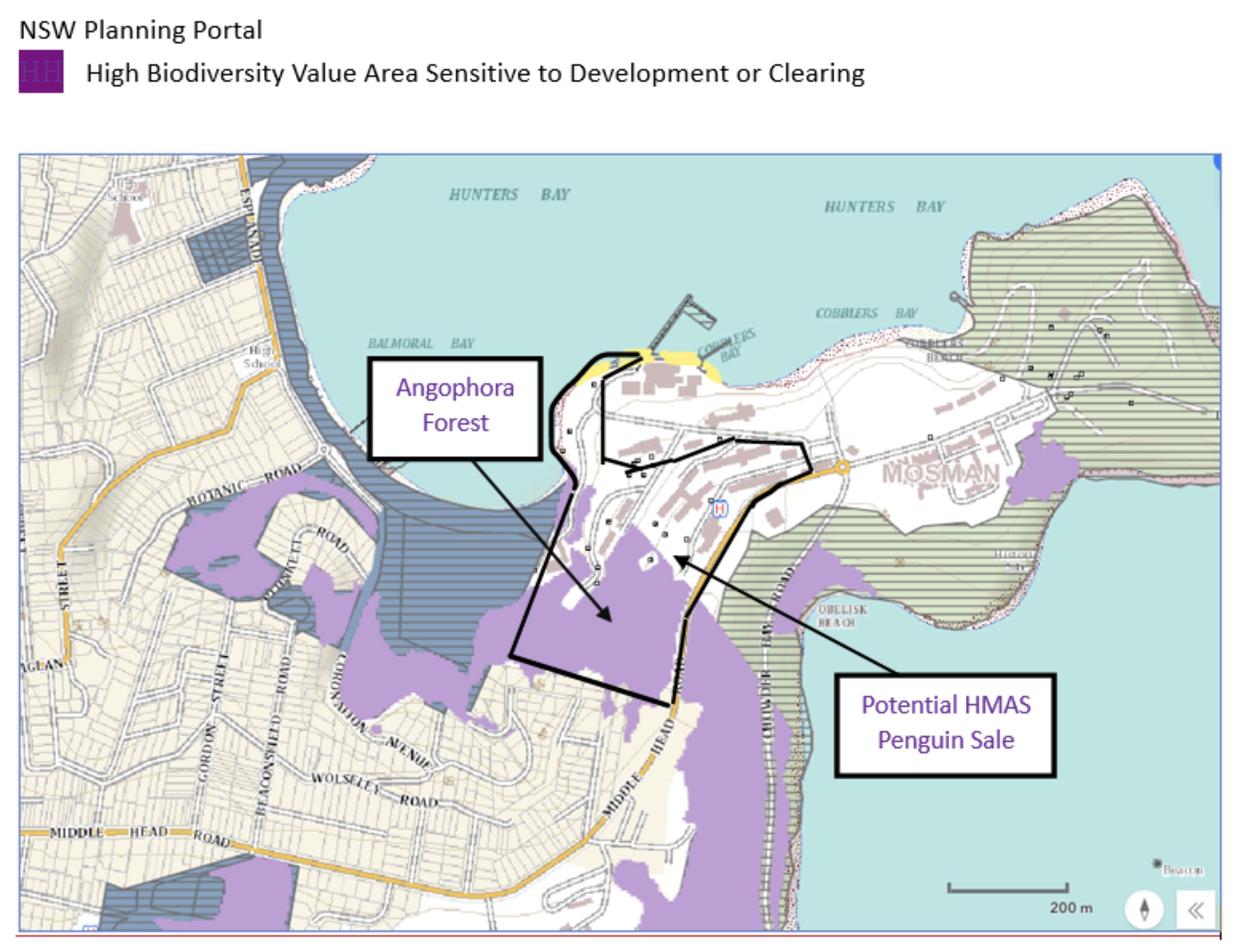
The Angophora Forest has been designated by DPE as land with high biodiversity value particularly sensitive to impacts from development and clearing.
Angophora forests grow in shallow, nutrient-poor sandy soils with low cohesion that prevent erosion and landslip; land clearing is high-risk and often irreversible.
This site has a high likelihood of unrecorded Aboriginal heritage triggering NSW Heritage Act obligations, Aboriginal cultural heritage due diligence requirements and potential Federal EPBC Act implications.
Clearing would represent a permanent loss to Sydney’s natural character, international appeal and public lands forever.
2. Ecological Value
Two Plant Community Types are represented – Sydney Coastal Sandstone Foreshores Forest (PCT 3594) at the higher area, and a smaller area of Sydney Coastal Enriched Sandstone Forest (PCT 3592) nearer to and adjoining Balmoral Oval.
Sydney Coastal Sandstone Foreshores Forest is a tall, sclerophyll open forest dominated by Angophora costata – the tree that gives its name to this HMAS Forest. Other trees include Eucalyptus botryoides and in the mid-stratum, Banksia integrifolia and Allocasuarina littoralis. Mesic species include Pittosporum undulatum, Glochidion ferdinandi and Elaeocarpus reticulatus. The ground layer is characterised by ferns such as Calochlaena dubia and grasses. A fire occurred in the forest approximately 18 months ago and has affected some of the lower storey vegetation, resulting in a similar height in the understorey species and a proliferation Calochlaena dubia.
Sydney Coastal Enriched Sandstone Forest is moister, with a slightly different mid and understory. Yet it maintains its characteristic canopy of Angophora costata.providing habitat for fauna such as water dragons and amphibians.
2.1 Keystone Species: Angophora costata
Angophora costata is endemic to eastern Australia, occurring primarily in coastal NSW ecosystems. These are found typically on sandstone-derived soils, forming part of dry sclerophyll forest systems such as the Sydney Coastal Sandstone Foreshores Forest Community.
It is a large, spreading tree, growing up to 30 metres. First Nations people from the Sydney region referred to it as the ‘Grandmother tree’ because the ways the boughs grow can appear like an embrace.
Acting as a keystone species within its ecosystem it provides vital habitat and resources. Angophora costata is particularly crucial for supporting biodiversity in the Sydney basin and surrounding sandstone environments. It is a long-lived species (often 100+ years) and resilient to fire using lignotubers and epicormic buds to regenerate quickly after bushfires.
2.2 Ecological role:
A mature Angophora will provide vital ecological hollows for arboreal animals and birds including owls, over a long period for nesting.
Flowers provide nectar and pollen for bees and other insects, native animals such as ring and brush tailed possums, grey-headed flying foxes (Pteropus poliocephalus), so important for the pollination of native forests and classified as threatened (NSW) and vulnerable (EPBC Act 1999). The forest supports bird species such as rainbow lorikeets and red wattle birds.
The tall trees, leaf litter, shed bark, fallen logs, and rock outcrops of Angophora forests, particularly sandstone forests such as the Sydney Coastal Sandstone Foreshores Forest, support diverse invertebrate communities. A variety of snakes including green tree snakes, water dragons, blue tongue lizards, skinks, and geckos are supported. There is an anecdotal observation of a turtle being in the HMAS Penguin forest.
The damp, rocky, and often steeply sloped environment of an Angophora Forest, particularly the Sydney sandstone forests, provides ideal habitat for various species of ground-dwelling and tree frogs.
The Red-crowned Toadlet (Pseudophryne australis) is listed as vulnerable. This species is strongly associated with sandstone habitats, including Angophora forests, where they shelter under sandstone rocks and leaf litter in damp, sheltered areas. It is listed as a vulnerable species in New South Wales (NSW) under the Biodiversity Conservation Act 2016. It is restricted to the Sydney Basin and threatened by urban development and habitat loss. The author has observed them while bush regenerating on Chowder Head in a similar forest and not far from the HMAS Penguin Angophora Forest.
2.3 Mature Angophora Forests
These forests provide essential features for Powerful Owl (Ninox strenua) breeding success including large hollow-bearing trees required for nesting and roosting trees with dense canopies for daytime roosting.
The forest provides foraging areas of complex vegetation structure large enough to support abundant prey populations such as possums and birds.
Implications:
Tree hollows suitable for Powerful Owls typically take >100–150 years to form.
Removal of mature Angophora stands leads to disproportionate biodiversity loss, as they function as habitat “nodes” in fragmented urban bushland.
Loss of mature Angophora at HMAS Penguin would represent a long-term or permanent loss of breeding habitat.
2.4 Habitat Networks and Threatened Species
Angophora species are components of heavily fragmented habitat for endangered species. Such habitat is already heavily fragmented across Sydney Harbour.
The HMAS Penguin forest forms part of a regional habitat corridor linking Middle Head / Georges Heights bushland, Balmoral slopes and Sydney Harbour National Park remnants.
This network forms part of a harbour-wide habitat corridor used by mobile species such as the Powerful Owl. Loss would further fragment already fragile and diminished ecosystems.
Implications:
Clearing or fragmentation would break foraging pathways, reduce territory viability and increase risk of local extinction.
3. Powerful Owl – Conservation Significance
3.1 Status
In NSW the Powerful Owl is listed as Vulnerable under the NSW Biodiversity Conservation Act 2016.
Nationally, the Powerful Owl is recognised as a species of conservation concern.
3.2 Habitat Requirements
The Powerful Owl requires:
Large territories (typically 300–1000 hectares)
Pairs of Powerful Owls demonstrate high fidelity to a large territory, the size of which varies with habitat quality and thus prey densities. In good habitats a mere 400 ha can support a pair when prey are dense. Where hollow trees and prey have been depleted, the owls need up to 4000 ha.
Mature forest with tree hollows for nesting
Powerful Owls nest in large tree hollows (at least 0.5 m deep), in large eucalypts (diameter at breast height of 80-240 cm) that are at least 150 years old. While the female and young are in the nest hollow the male Powerful Owl roosts nearby (10-200 m) guarding them, often choosing a dense "grove" of trees that provide concealment from other birds that harass him.
Proximity to prey-rich environments are required for Powerful Owls.
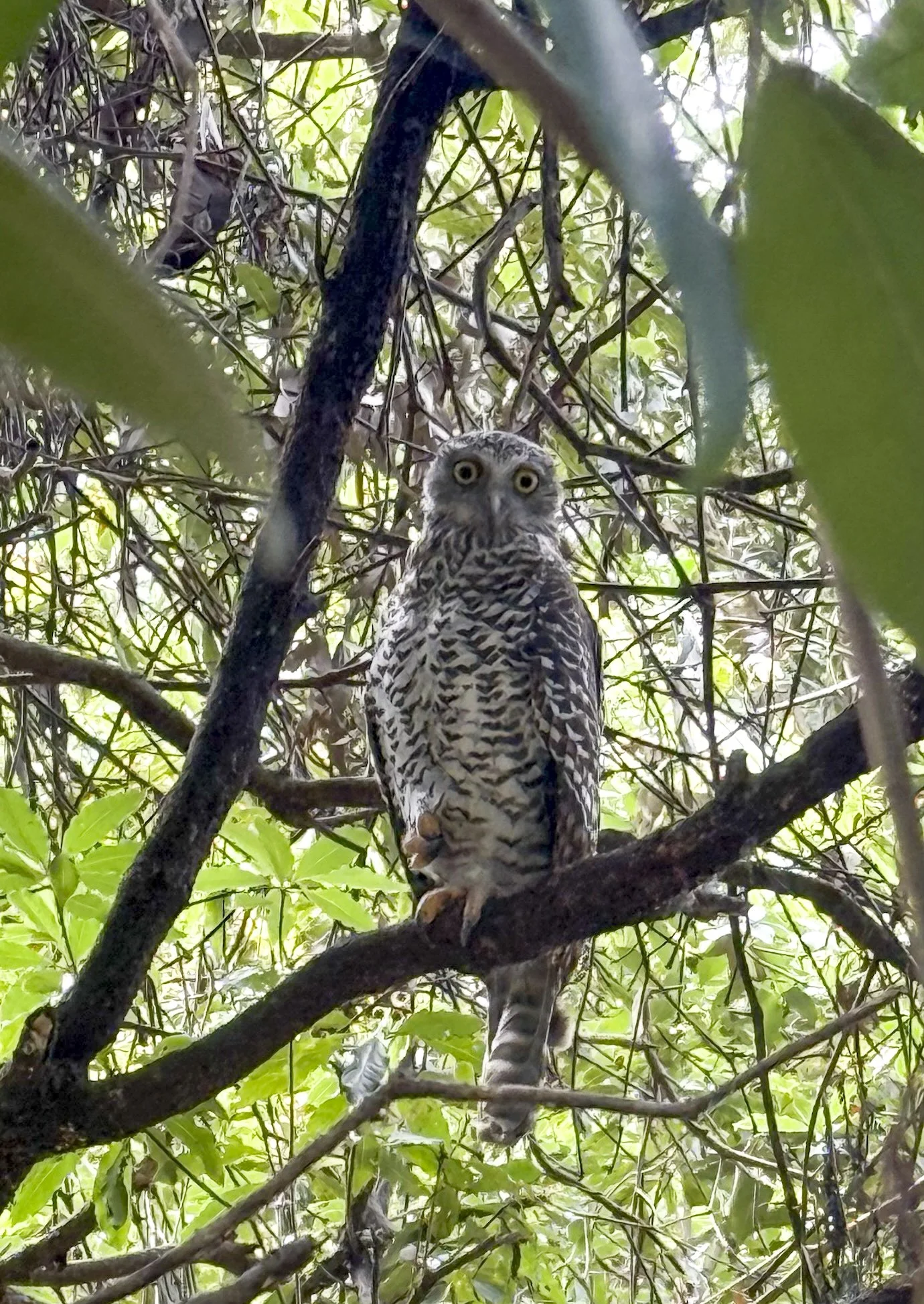
ABOVE: This Powerful Owl was photographed near the HMAS Penguin Angophora Forest by Janet Bagnall, Citizen Scientist, who has been observing the presence of the species for several years.
3.3 Diet and Harbour Ecology
Primary prey:
Possums (ringtail and brushtail) make up the bulk of prey in the coastal habitat.
Other main prey items are medium-sized arboreal marsupials, particularly the Greater Glider, Common Ringtail Possum and Sugar Glider. There may be marked regional differences in the prey taken by Powerful Owls. For example, in southern NSW, Ringtail Possum make up the bulk of prey in the lowland or coastal habitat. At higher elevations, such as the tableland forests, the Greater Glider may constitute almost all of the prey for a pair of Powerful Owls. Flying-foxes are important prey in some areas; birds comprise about 10-50% of the diet depending on the availability of preferred mammals. As most prey species require hollows and a shrub layer, these are important habitat components for the owl.
Other prey include Gliders (not plentiful in areas close to the Harbour), Flying-Foxes and large birds when mammal species are not so available.
Implications:
Sydney Harbour bushland remnants — including Mosman headlands, HMAS Penguin and the Angophora Forest — are known to support these prey species.
Remnant patches like HMAS Penguin are vital as roosting habitat and foraging stepping stones within fragmented urban landscapes.
Hollow-bearing trees are irreplaceable in the short-to-medium term (often 80–150 years to form).
4. Ecological Cascade Risk
Removal or disturbance of Angophora habitat would result in cascading effects:
Critical Powerful Owl nesting sites would be removed,
Necessary prey populations (possums, arboreal mammals) would be unavailable and
And invertebrate and bird diversity would be seriously impacted.
Implications:
A cascading loss of biodiversity, not just a single species impact, would result permanently.
5. Threatened Species
A number of threatened fauna and flora species are at risk should the Angophora Forest be removed or disturbed by development on or near HMAS Penguin land.
5.1 Fauna
The Powerful Owl (Ninox strenua) - Listed as Vulnerable in NSW under the NSW Biodiversity Conservation Act 2016. It is heard and observed in the forest and in nearby bushland.
The Grey-headed flying fox (Pteropus poliocephalus) is classified as threatened (NSW) and vulnerable (EPBC Act 1999). Flying foxes rely on flowering Angophora for food.
The Red-crowned Toadlet (Pseudophryne australis) listed as vulnerable in New South Wales (NSW) under the Biodiversity Conservation Act 2016. Its presence is probable.
5.2 Flora
Acacia terminalis subsp. Eastern Sydney
Acacia terminalis subsp. Eastern Sydney (Sunshine Wattle) is listed as Endangered under both the NSW Biodiversity Conservation Act 2016 and the Commonwealth Environment Protection and Biodiversity Conservation Act 1999.
Range: Limited to the eastern suburbs of Sydney, spanning approximately 23 km from the northern shores of Sydney Harbour to Botany Bay (including localities like Manly, Mosman, and Randwick).
Threats: Habitat loss due to urbanization, encroachment by weeds, and grazing by rabbits.
Distribution: Occurs in sandy soils, often within coastal scrub, heath, and open eucalypt woodlands.
Recovery Action: Listed as a Site-Managed Species under the NSW Saving our Species program. It is highly distinct from other subspecies due to its localized habitat, and it is a key species found within the critically endangered Eastern Suburbs Banksia Scrub ecological community.
The BioNet Threatened Flora Species Records indicate the existence of this species close to the Angophora Forest. A survey of the flora within the HMAS Penguin forest is required to ascertain whether the species exists within it.
Implication:
The site has high likelihood of unrecorded flora and fauna, triggering:
The need for a formal Ecological Study
NSW Biodiversity Conservation Act obligations under the NSW Saving our Species program
Potential Federal EPBC Act implications
6. Landscape and Heritage Value
6.1 Commonwealth Heritage Listing
Both the HMAS Penguin built environment and the Angophora Forest are Commonwealth Heritage listed.
Angophora forests are visually and culturally iconic in Sydney’s harbour landscape.
6.1 Biodiversity
The NSW Department of Climate Change, Energy, the Environment and Water developed the Biodiversity Offsets Scheme to provide a mechanism to avoid, minimise and offset the impacts of development and some types of clearing on biodiversity in New South Wales.
The Biodiversity Values Map (BV Map) identifies land with high biodiversity value that is particularly sensitive to impacts from development and clearing. The BV Map is one of the triggers for determining whether the Biodiversity Offset Scheme (BOS) applies to a clearing or development proposal.
The BV Map has been prepared by the Department of Planning and Environment (DPE) under Part 7 of the Biodiversity Conservation Act 2016 (BC Act).
The Angophora Forest adjacent to HMAS Penguin has been designated as land with high biodiversity value:
Implication:
This site is recognised as one of significant heritage value and biodiversity value. Formal assessments are required to examine this significance and the necessary protections.
7. Geological and Soil Significance
7.1 Sandstone Landscape Stability
Angophora forests are closely tied to Hawkesbury sandstone geology. They grow in shallow, nutrient-poor sandy soils with low cohesion.
7.2 Environmental function:
Angophora and other root systems stabilise slopes and prevent erosion and landslip.
The vegetation cover reduces stormwater runoff velocity.
Removal of the Angophora Forest increases risk of sediment movement into Sydney Harbour and slope instability, which is critical in the steep terrain at this Mosman site.
Implications:
Clearing vegetation on these slopes is high-risk and often irreversible.
8. Archaeological and Aboriginal Cultural Value
Evidence from comparable Angophora sites in Sydney shows:
Angophora bushland areas frequently contain Aboriginal shelters, middens, and artefacts.
One Angophora reserve in Sydney contains human remains and high scientific archaeological value.
Cultural context:
Angophora trees were known and used by Aboriginal people (recorded traditional name “kajimbourra”). First Nations people from the Sydney region referred to it as the ‘Grandmother tree’ because of the growth of its branches appear like an embrace.
Aboriginal sites within Angophora forests, often feature significant occupation sites, hand representations, and middens.
Coastal sandstone ridges (like HMAS Penguin) are associated with:
Seasonal movement pathways
Food gathering
Ceremonial landscapes
Protection: Aboriginal heritage sites are protected in NSW under the National Parks and Wildlife Act 1974
Implications:
The site has high likelihood of unrecorded Aboriginal heritage, triggering:
NSW Heritage Act obligations
Aboriginal cultural heritage due diligence requirements
Potential Federal EPBC Act implications
9. Strategic Planning and Public Value
9.1 Landscape and Heritage Value
Angophora forests are visually and culturally iconic in Sydney’s harbour landscape.
HMAS Penguin and the Angophora Forest contribute to the scenic and historical defence values of Sydney Harbour. Public amenity and walking corridors extend through the area contributing to the iconic Bondi to Manly walk.
A unique walkway from Middle Head Road to the Balmoral oval winds downward along the edge of the Angophora Forest.
9.2 Public Interest Factors
There is an increasing scarcity of intact harbour bushland around Sydney Harbour that attracts many visitors from Australia and overseas.
The walking track beside the Angophora Forest is a highly enjoyed feature along the Bondi to Manly Walk.
Climate resilience as we move toward our Zero by 2050 target must be considered to have a positive impact on urban cooling and carbon storage through our forests.
HMAS Penguin is intertwined in the Mosman culture and community, with positive impacts on wellbeing.
Sydney Harbour is an esteemed icon and the remaining bushland represent the lungs of Sydney.
9.3 Risk of Privatization
Sale to private interests would likely result in:
Vegetation clearing pressures, increased risk to threatened species and corrosion
Restricted access and damage to the popular Bondi to Manly walk
Loss of biodiversity and ecological connectivity
Increased congestion and development without necessary infrastructure
Implications:
Clearing would represent a permanent loss to Sydney’s natural character, international appeal and public lands forever.
10. Key Argument Summary
The Angophora Forest at HMAS Penguin is:
A remnant sandstone ecological community with high biodiversity value
A critical habitat node supporting protected and mobile species
A probable critical vegetation node requiring an ecological study
A geologically sensitive slope system requiring vegetation for stability
A probable Aboriginal cultural landscape with archaeological potential
A visually and culturally significant harbour asset
Therefore:
Its disposal into private ownership presents unacceptable environmental, cultural, and public interest risks.
11. Recommendations
Immediate ecological and cultural heritage assessment prior to any divestment
If divestment proceeds, consider transfer to Sydney Harbour Federation Trust
Recognition as:
Conservation zone
Potential heritage landscape
4. Inclusion in Sydney Harbour bushland corridor protection strategy
12. References
Angophora ecology and distribution – Angophora costata profile
Habitat and soil associations – Australian Plants Society
Endangered ecological community listing – NSW Scientific Committee
Aboriginal archaeological significance in Angophora bushland – Northern Beaches Council
Science Direct Biological Conservation Vol 243
SWIFFT: State Wide Integrated Flora and Fauna
Powerful Owl Coalition: Protecting Powerful Owls in Sydney
BioNet Threatened Flora Species records
NSW Planning and Environment