Our submission to the Senate Inquiry.
Mosman Parks & Bushland’s submission to the Senate Inquiry Into the Management of Defence Estate Assets
Sydney Harbour foreshore land is finite, nationally and internationally significant heritage land. Once sold this land is lost to the public forever.
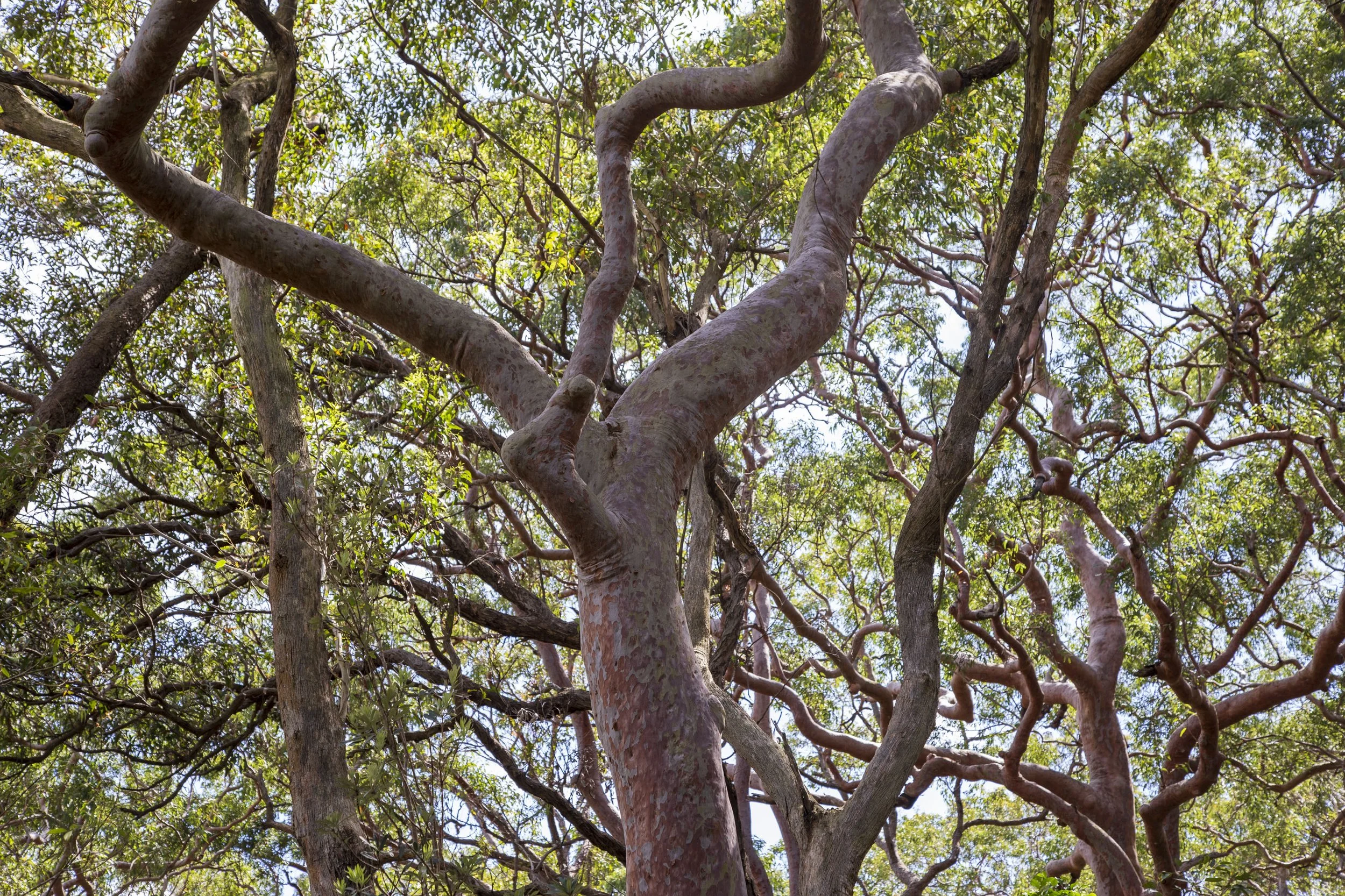
ABOVE: HMAS Penguin’s Angophora forest. (Image – Michael Mangold)
Read the submission below or
download a PDF copy here >
Submission to the Senate Inquiry into the Management of Defence Estate Assets
HMAS Penguin and Angophora Forest to be Retained in Public Ownership
Submitted by
Kate Eccles
MPBA President
17 April 2026
Mosman Parks & Bushland Association (MPBA) appreciates the opportunity to provide a submission to the Senate Foreign Affairs, Defence and Trade References Committee Inquiry into the Management of Defence Estate Assets.
1. Executive Summary
The Mosman Parks & Bushland Association (MPBA) has been protecting the natural environment and public land since 1964 and has played a major role in preserving Mosman’s individual character and landscape. The Association’s main objective continues to be the protection of bushland and public land in Mosman for the benefit of current and future generations.
Our Association has a long history of advocating for the protection of the HMAS Penguin site. Our archives include records of environmental advocacy dating from the 1960’s and continuing to the present time as we make this submission.
MPBA acknowledges that Australian Defence spending is increasing significantly. We recognise that the Senate Committee is looking at more than 70 sites and that some of these will be suitable for divestment and changed land use. MPBA considers that HMAS Penguin is not suitable for divestment.
The HMAS Penguin site which includes the Angophora Forest is a Nationally significant site, located on the foreshores of Sydney Harbour. It must remain as public land in perpetuity. It should not be sold for the reasons outlined in this submission.
In this submission, MPBA addresses the following Terms of Reference included in paragraphs e., g. and h. below. These are our central concerns.
e. the heritage significance of Defence estate assets and the adequacy of measures to protect that significance during and following divestment, including the impact on veteran and community connections to sites of military service;
g. consideration of an amended policy framework for the use of surplus Defence land that prioritises alternative public uses over private development; and
h. any other related matters.
This submission argues that the proposed divestment of HMAS Penguin will undermine Commonwealth environmental responsibilities, ignore public custodianship aligned with Heritage protection, and represents a fundamental shift in how the Commonwealth treats Sydney Harbour land, with irreversible consequences.
Key points:
The buildings, landscape and setting are Commonwealth Heritage listed and must remain in public ownership for community, environmental, heritage and national interests.
The site includes remnant Angophora forest, sensitive bushland and a fragile coastal ecosystem with a bushland corridor forming part of the Bondi to Manly coastal walk.
HMAS Penguin is of significant historical and heritage value. The site is part of the wider “1870 defence lands”. These lands also include adjoining land at Middle Head which the Harbour Trust manages. Penguin is a site of National significance. Locally it is integral to the Mosman community and its identity.
Defence holds this land in trust on behalf of the nation and precedents exist for other Sydney Harbour sites retained in public ownership.
Should Defence have no use for part of the site, transferring that part of the site to the Sydney Harbour Federation Trust would ensure long-term protection, public benefit and environmental stewardship. The Trust has experience and expertise in successfully managing significant sites like Penguin.
2. Heritage Significance of HMAS Penguin and Angophora Forest
The HMAS Penguin Commonwealth Heritage listing (Place ID 105581) refers to HMAS Penguin as a place of exceptional interest:
It illustrates the design of a purpose-built Naval training and hospitalisation complex erected during WWII.
The aesthetic characteristics of the buildings display a consistent theme influenced by nautical features and united by similar brickwork and green terracotta tile roofs described as Inter-War Stripped Classical Style.
The buildings are important visual elements in the landscape and are landmark features in their own right, in a landscape in which trees, gardens and topography contribute to a significant cultural landscape.
Included in this Commonwealth Heritage listing is a rare and ecologically significant Angophora forest, a remnant forest of high environmental, visual, and ecological value.
The importance of this bushland corridor has been publicly recognised for decades. During the 1980s proposed development pressures were unsuccessful as the site was deemed an environmentally significant part of a functioning ecological network along Sydney Harbour, supporting high native species diversity providing habitat for threatened fauna including the Powerful Owl and the Grey-headed Flying Fox.
The Angophora forest is part of a sensitive and historically defended ecological system.
When the Balmoral to Harbour Trust headland walkway was constructed, specific environmental mitigation safeguards were required to prevent damage to the same vegetation system now potentially affected by land disposal. This walkway runs from Middle Head Road to Balmoral and sits immediately to the west of the Angophora Forest site. This walkway, a small scale public infrastructure project, adjacent to the Angophora Forest, required careful ecological mitigation. Any larger-scale change in land use of the Angophora Forest site itself would carry significantly greater risk.
The disposal may trigger obligations under the Environment Protection and Biodiversity Conservation Act 1999 (EPBC Act) where actions impact threatened species or ecological communities, affect National Heritage values and/or involve Commonwealth land.
Divestment would need to be considered as a potential controlled action requiring full federal environmental oversight and the Commonwealth must uphold its environmental responsibilities to protect it.
This is not vacant land:
This land forms part of a recognised ecological community spanning the Balmoral slopes and Sydney Harbour foreshore, intact vegetation that is increasingly rare and environmentally significant.
It forms part of the Bondi to Manly coastal walk, of national and international significance.
Disposal risks fragmentation and inappropriate development. The Commonwealth Heritage listing signals protection – not privatisation.
3. Public Policy for Sydney Harbour Surplus Defence Land
The proposed divestment of HMAS Penguin represents a significant breach and unjustified departure from over 40 years of consistent Commonwealth policy governing Sydney Harbour Defence land.
A 1979 Agreement between Prime Minister Malcolm Fraser and NSW Premier Neville Wran established a framework for the transfer of “surplus to requirements” Defence land into public ownership, enabling the creation and expansion of Sydney Harbour National Park.
The 1979 Fraser-Wran precedent became a strong political convention – Sydney harbour defence land went to public ownership, not sale. It enabled the transfer of significant harbour foreshore parcels into public ownership, including Middle Head/Georges Heights, North Head, South Head and Dobroyd Head.
Successive governments maintained the principles resulting in the creation of the Sydney Harbour Federation Trust in 2001. This allowed the Trust to manage former Defence lands for public benefit.
The model retained land in public ownership, ensured public access and adaptive reuse, protected heritage and environmental values and explicitly avoided private disposal.
The Fraser-Wran agreement and subsequent practice establish a legitimate expectation that Harbour Defence land will remain in public ownership and disposal decisions will prioritise public benefit.
The Commonwealth disposal of land must be exercised consistently with established policy frameworks, intergovernmental understandings and public interest considerations. There is no clear precedent for the sale of Sydney Harbour Defence foreshore land into private ownership.
A key solution enabling the environmental and heritage protection, public access and continued public benefit of HMAS Penguin and Angophora forest is the transfer to the Sydney Harbour Federation Trust.
This mechanism ensures that Sydney Harbour foreshore land remains publicly accessible, environmental and heritage values are protected, and strategic public assets are not permanently alienated.
There is no meaningful precedent for the sale of Sydney Harbour defence foreshore land into private hands. Harbour defence land is not a disposable financial asset, but a shared national asset.
The Fraser-Wran framework has been consistently applied in practice across multiple governments of different political persuasions, creating a legitimate and enduring public expectation. The creation of the Sydney Harbour Federation Trust in 2001 reinforced this principle.
4. Other Related Matters – Historical and Cultural Background
Middle Head and surrounding headlands lie within the traditional Country of the Cammeragal (part of the larger Guringai nation). Aboriginal cultural values include deep connections to land and water, landscape interpretation and historical occupation patterns.
The headlands around Middle Head and Georges Heights were reserved for harbour defence long before Penguin was established. Sydney’s early colonial authorities fortified this location to protect Sydney Harbour from potential navy threats.
Nearby fortifications at Middle Head date back to 1801 and were continually updated up to 1942, showing the long military relevance of the landscape around HMAS Penguin.
HMAS Penguin was commissioned in 1942 as part of Navy Fleet Command. HMAS Penguin is recognised for its place in Australia’s defence story, leading to the Commonwealth Heritage listing and protections under the Environment Protection and Biodiversity Conservation Act 1999. Any sale or redevelopment must manage its heritage values.
HMAS Penguin is part of Sydney Harbour’s shared legacy. It is not surplus land – it is a community, environmental and cultural asset. Rather than selling the site, the Government should transfer HMAS Penguin into public stewardship, the Sydney Harbour Federation Trust. This model has been applied successfully to other former defence sites around Sydney Harbour.
5. Recommendations
We recommend that the Senate Committee for the Management of Defence Estate Assets agree that:
The HMAS Penguin site, which includes the Angophora Forest, should remain in public ownership in perpetuity, having regard to its Nationally significant heritage and environmental values
The Sydney Harbour Federation Trust is the most appropriate body to continue as the steward for any part of the site not required for HMAS Penguin’s operations
Any proposed disposal be subject to full environmental and Commonwealth Heritage assessment
6. Conclusion
Sydney Harbour foreshore land is finite, nationally and internationally significant, and central to our public identity. HMAS Penguin is not an isolated Defence holding, but a critical link in a continuous system of publicly owned Sydney Harbour foreshore. Its sale would introduce fragmentation into a landscape that has, for over four decades, been deliberately consolidated for public benefit, consistent with community expectations and principles of intergenerational equity.
The HMAS Penguin and Angophora Forest site is Commonwealth Heritage-listed public land that belongs to the Australian people – it must remain in public hands for public benefit in perpetuity, not be sold for private benefit. One solution, transferring surplus Defence land to the Sydney Harbour Federation Trust, ensures long-term protection, public access, and environmental stewardship.
Once sold, this Nationally significant land is effectively lost to the public forever.