Yes, ‘divest’ means sell!
The Defence and Finance Departments of the Commonwealth Government are preparing to “divest” most of HMAS Penguin on Middle Head. Does “divest” mean sell? Yes it does!
This is public land – our land. Once “divested” to private interests it is lost forever.
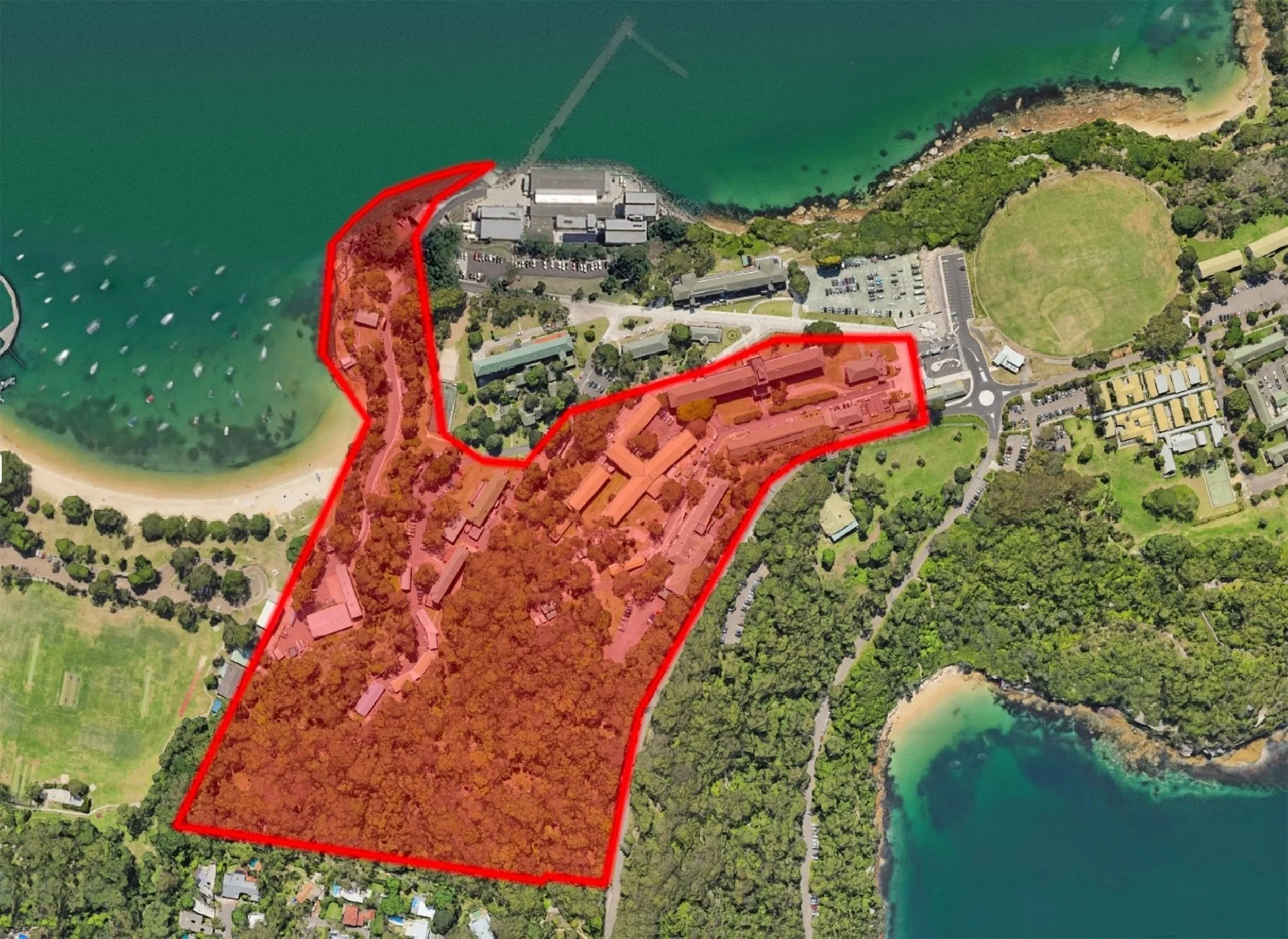
ABOVE: graphic showing HMAS Penguin lands and buildings to be sold in red (image – Headland Preservation group).
Background Paper and Position
Read our paper below or download a PDF copy here >
PROPOSED DIVESTMENT OF PARTS OF HMAS PENGUIN – MOSMAN PARKS & BUSHLAND (MPBA) POSITION PAPER
The HMAS Penguin site which includes the Angophora Forest is heritage-listed public land that belongs to the Australian people – it must remain in public hands for public benefit, not sold for private benefit. If parts of HMAS Penguin are to be divested, we consider that a transfer to the Sydney Harbour Federation Trust would provide long term protection, public access and environmental protection.
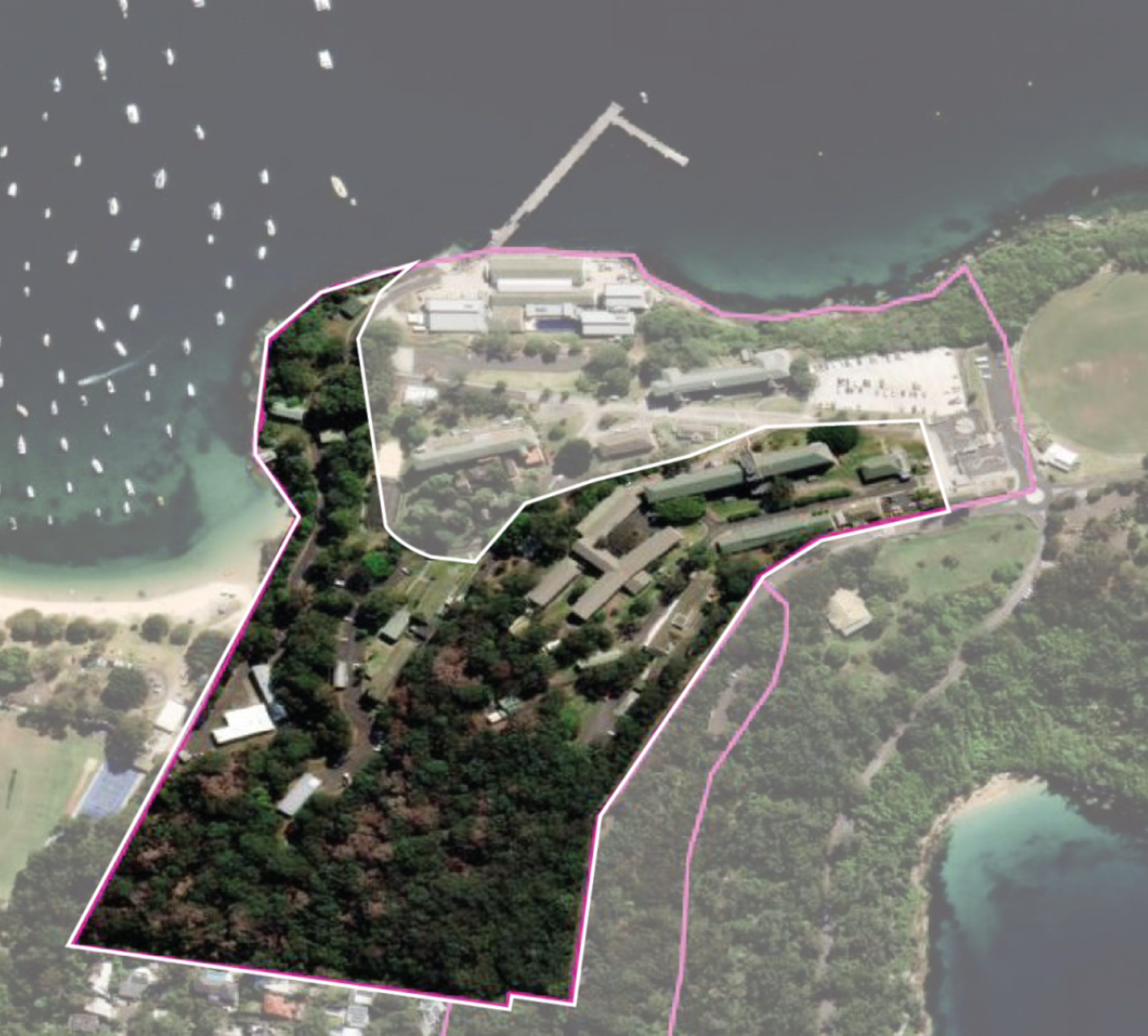
ABOVE: The HMAS Penguin site has a line around it. (Ignore the pink line showing a walking track through the trees to the east of Middle Head Road) The land shown without the white veil over it is the portion of HMAS Penguin that is proposed for divestment.
MPBA AIMS AND OBJECTIVES – BUSHLAND AND PUBLIC LAND
The Mosman Parks & Bushland Association (MPBA) was founded in 1964 by a group of Mosman residents alarmed at the loss of public bushland. Among the founding members were Joan and Eileen Bradley, originators of the Bradley method of bush regeneration.
The principal activities of the Association continue to be the practical maintenance of bushland and the protection of public land.
PROTECTING PUBLIC LANDS - PRINCIPLES
Public lands belong to the people.
No National, State or Local government ‘owns’ public lands. They are held in trust for the people of Australia.
Public land that is of significance must remain in public ownership.
Public land is of significance where it is of national, environmental, heritage, natural, cultural, social, historic, scientific, aesthetic, ecological, indigenous, community value
or
is capable, at present or in the future, of having a value or use, the benefit of which to the public, outweighs any benefit from sale or alienation by lease.
In relation to public land of significance there should be
No privatisation
Proper protection and conservation
Proper and genuine consultation with the public
THE SIGNIFICANCE OF HMAS PENGUIN
1. Significance of its Position
HMAS Penguin’s position on Middle Head, Sydney Harbour makes it strategically, historically, environmentally and scenically important.
Position on Sydney Harbour at the entrance to the Heads – a little history
Middle Head and Georges Heights were part of the system of Defence reserves from the earliest days of the colony, when any threat to Sydney would have come from the sea.
Fortifications, barracks and the Military Road system to support them were constructed.
Subdivision of land for housing in Mosman took place, and the Municipality of Mosman was established in 1893. The headland became a recreation and viewing area but maintained its primary function of defence.
Following Federation, defensive works and military land became the responsibility of the Commonwealth government.
Two portions of defence land were leased to Mosman Council for public recreation.
The 9 hole golf course on Middle Head included land that was resumed in 1940 during WWII for the establishment of HMAS Penguin.
A swimming pool at Balmoral, known as the Mosman Septic Tank because of its earlier function, was also resumed and incorporated into the HMAS Penguin land.
Except for HMAS Penguin, the land on Middle Head and Georges Heights is now “owned” by NSW National Parks & Wildlife and the Harbour Trust.
Position in relation to other land on Middle Head/Georges Heights
HMAS Penguin is bordered by
the Harbour Trust (Georges Heights)
Mosman residences (Cobbittee Street)
Balmoral Park (Mosman Council)
The Harbour Trust (beyond Middle Head Oval)
Its Angophora forest forms a bookend to the green of the headland and a continuation of the green open space of Balmoral Park to the vegetated heights of Georges Heights.

ABOVE: Angophora at Middle Head (photo by Jill White)
Significance of the Angophora Forest
We are considering the Angophora forest before the significance of the built environment, because it combines the two objectives of Mosman Parks & Bushland – the conservation of bushland and the protection of public land.
Environmental, Ecological and Natural Significance
The land containing the Angophora Forest is a significant piece of Sydney Harbour’s remnant bushland.
Due to its long-term use as a military base, the site has been shielded from urban development, preserving much of the original, native landscape.
The Angophora costata (Sydney Red Gum) trees are typical of the Sydney Coastal Sandstone Foreshores Forest
The forest is significant ecologically in its own right, but also as part of the bushland corridor that extends from Balmoral to the Middle Head ridgeline of the Harbour Trust and beyond to the Sydney Harbour National Park’s bushland and escarpments. Such bushland corridors are increasingly rare, and increasingly significant ecologically in the protection of native flora and fauna.
Barry Lancaster, our Mosman birding authority says “ Not just in Mosman, but all over the Sydney Basin we are losing birds. The disconnection of habitat means that common species living in small groups just disappear and become locally extinct. Let us not make the situation any worse than it already is by destroying more habitat.”
Any private development would increase the ecological pressure on the forest itself and the sensitive nearby bushland corridors.
Care is being taken by HMAS Penguin and the Harbour Trust to minimise risks of fire and of Phytophthora cinnamomi to this highly valued ecosystem.
Scenic Significance
The Bondi to Manly Walk
The track from Chowder Bay (Clifton Gardens) to Middle Head Road and downhill to Balmoral Park forms part of the famous Bondi to Manly Walk. The walk is described as “an epic coastal and harbour-side walking track between Australia's two most famous surf beaches”. The track descends from Middle Head Road, alongside HMAS Penguin Angophora Forest, to Balmoral Park, giving local walkers and tourists from afar, a wonderful experience of Sydney’s remnant bushland and Angophora trees.
The Angophora Forest is part of the scenic area from Balmoral around Middle Head, Georges Heights, Chowder Head, and Bradley’s Head. It is inconceivable that part of this scenic area could just be chopped off and turned over to luxury housing.
The national Significance of Sydney Harbour
Enjoyment of the scenery of the harbour foreshores from the waters of the Harbour or from the air.
The three headlands – North, Middle and South – were all defence lands and retain some degree of natural vegetation plus their historical value. In combination, they make a beautiful entrance to the Harbour. The proposed divestment of part of Middle Head destroys that completeness.
Mosman Parks & Bushland advocated and lobbied for the protection of Mosman’s Scenic Protection Area for many years. Sydney Harbour with its headlands, its foreshore recreation areas, its bushland, its parks and National Parks all contribute to the visual amenity of a nationally and internationally recognized icon. The Angophora Forest, its green bushland and tall trees contribute to the scenery of Sydney Harbour.
Significance of the Built Environment
Commonwealth Heritage Listing
The built environment and the surrounding native bushland are listed as Commonwealth Heritage site (Place ID 105581)
The whole 16.64 hectare site, buildings and landscape, is Commonwealth Heritage listed, described in the listing as having “exceptional” significance.
Established in 1940 HMAS Penguin features:
1942-45 buildings in the Inter-War Stripped Classical Style and
a significant Angophora forest.
HMAS Penguin including its buildings, is significant as the focus of Naval training and hospitalisation in Sydney Harbour since 1940. From 1951 – 1964 the base was the main submarine base in Sydney Harbour, reinforcing its strategic role and importance in naval defence.
Rarity
HMAS Penguin is of exceptional heritage and historic interest in that it is a fine example of a purpose built Naval training and hospitalisation complex erected in 1940 -45 during the Second World War.
Aesthetic characteristics
A consistent style – Inter war Stripped Classical Style, is consistent and influenced by nautical features, and with similar brickwork and green terracotta tiled roofs
Social and community value
HMAS Penguin is highly valued by the Mosman community for its symbolic, cultural and social associations. This was demonstrated by fierce resistance to the first attempt to sell the Angophora Forest in 1988.
COMMONWEALTH HERITAGE PROTECTION
The buildings, landscape and setting are Heritage listed
Divestment risks inappropriate development and public custodianship aligns with Heritage obligations
Sydney Harbour defines Australia internationally, its values must be preserved
HERITAGE LISTING MEANS PROTECTION – NOT PRIVATISATION
THE PROPOSED DIVESTMENT
The Department of Defence wishes to retain some of the HMAS Penguin’s land for functions considered critical for operations.
And to divest (sell at market value) the land which it doesn’t need for those critical operations i.e. land considered to be surplus to requirements
The entire site is heritage-listed.
Divested land at HMAS Penguin would include the Angophora Forest. Land, sold at market value in Mosman would surely mean luxury housing, probably towers.
The disposal may trigger obligations under the Environment Protection and Biodiversity Conservation Act 1999 (EPCA Act) where actions impact threatened species or ecological communities, affect National Heritage values and/or involve Commonwealth land.
Divestment would need to be considered as a potential controlled action requiring full federal environmental oversight and the Commonwealth must uphold its environmental responsibilities to protect it.
ABOVE: Aerial picture courtesy of HPG shows land proposed for divestment outlined in red. ThIS shows that some buildings are within the area proposed for retention. These are associated with the functions still considered critical Others are in the area proposed for divestment.
The coloured aerial photograph above shows that some buildings are within the area proposed for retention. These are associated with the functions still considered critical Others are in the area proposed for divestment.
This is not the first attempt to sell Defence land on Middle Head
The first was in 1988 when the Commonwealth government of the day ( Bob Hawke was PM) attempted to sell “10 precious acres of Sydney Harbour Foreshore Bushland”. It was the Angophora Forest that was ‘For Sale’.
Protesters included Tom Uren and Barry O’Keefe, other politicians of all persuasions, Mosman Councillors and people from Mosman, Sydney and NSW who gathered at Balmoral to protest.
The next attempt came in 1996.(This time it was a Liberal government led by John Howard) When sale of land at Middle Head and Georges Heights and other Defence lands around the Harbour was proposed, the community’s objections led eventually to Prime Minister Howard’s announcement in 1998 to establish the Sydney Harbour Federation Trust.
This attempt is being made by a Labor Government.
The Fraser Wran Agreement
If the current proposal for the divestment of HMAS Penguin succeeds, it will be the first time that a Commonwealth government has allowed a transfer of Sydney Harbour defence land out of public ownership.
A 1979 Agreement between Prime Minister Malcolm Fraser and NSW Premier Neville Wran established a framework for the transfer of “surplus to requirements” Defence land into public ownership, enabling the creation and expansion of Sydney Harbour National Park.
The 1979 Fraser-Wran precedent became a strong political convention – Sydney Harbour defence land went to public ownership, not sale. It enabled the transfer of significant harbour foreshore parcels into public ownership, including Middle Head/Georges Heights, North Head, South Head and Dobroyd Head.
Successive governments maintained the principles resulting in the creation of the Sydney Harbour Federation Trust in 2001. This allowed the Trust to manage former Defence lands for public benefit.
The model retained land in public ownership, ensured public access and adaptive reuse, protected heritage and environmental values and explicitly avoided private disposal.
The Fraser-Wran agreement and subsequent practice establish a legitimate expectation that Harbour Defence land will remain in public ownership and disposal decisions will prioritise public benefit.
The Commonwealth disposal of land must be exercised consistently with established policy frameworks, intergovernmental understandings and public interest considerations. There is no clear precedent for the sale of Sydney Harbour Defence foreshore land into private ownership.
A key solution enabling the environmental and heritage protection, public access and continued public benefit of HMAS Penguin and Angophora forest is the transfer to the Sydney Harbour Federation Trust.
This mechanism ensures that Sydney Harbour foreshore land remains publicly accessible, environmental and heritage values are protected, and strategic public assets are not permanently alienated.
There is no meaningful precedent for the sale of Sydney Harbour defence foreshore land into private hands. Harbour defence land is not a disposable financial asset, but a shared national asset.
The Fraser-Wran framework has been consistently applied in practice across multiple governments of different political persuasions, creating a legitimate and enduring public expectation. The creation of the Sydney Harbour Federation Trust in 2001 reinforced this principle.
The principle should also apply to the proposal to divest Spectacle Island.
FINANCIAL CONSIDERATIONS
HMAS PENGUIN IS PRICELESS. IT IS NOT FOR SALE.
The Department of Defence’s motivation for divesting its assets is largely financial.
To save the expense of upkeep and maintenance
To reap monetary gains from sales and to spend them on new Defence needs.
The Mosman Parks & Bushland Association is not qualified to make assumptions about Cost/Benefit and financial value.
We do question, however, whether the monetary gain from divesting assets such as HMAS Penguin, Victoria Barracks and Spectacle Island can possibly compensate the public for the loss of assets of such significance to all Australians.
STRATEGIC VALUE
Retaining the land as Commonwealth public land, in the hands of the Harbour Trust, would allow for future emergencies or in the event of war.
In light of the current world situation and future uncertainties, should the retention of the whole site as a Defence asset be reconsidered?
Warfare has changed since the early days of artillery defence and the convict construction of the 1801 fort. Naval warfare has also changed since HMAS Penguin was established in 1940.
We cannot foretell the future.
If the entire site is not needed for current defence purposes, keeping the land in public ownership is important. If the land is public, it could be made available for military purposes if needed in an emergency. It would not be available if sold into private ownership.
THE ALTERNATIVE TO SALE
Transfer the divested portion to Sydney Harbour Federation Trust
This provides for public access, adaptive reuse and conservation
It aligns with what the community expects
The lands would continue to have Commonwealth heritage protection
Sydney Harbour Federation Trust provides for a better solution to guarantee public access and environmental protection.
IF SOLD, THIS LAND IS LOST FOR EVER.
Kate Eccles OAM
President
17.4.2026